Immutable Audit Trail - KRYOS Dynamics
Cryptographic Audit

Immutable Audit Trail

SHA-3 family hashing, CRYSTALS-Dilithium post-quantum digital signatures, CRYSTALS-Kyber key encapsulation, and Hyperledger Fabric distributed ledger. Every decision produces a non-repudiable receipt of truth.

Interactive demonstration

Watch a decision receipt being anchored.

Immutable Audit Trail

Cryptographic Receipt of Truth

Idle

Every decision is permanently anchored with cryptographic proof. The system does not just store decisions; it locks them with mathematical verification.

Four verification layers. One immutable receipt.

Layer 1

Decision compilation

The system compiles the complete decision record: input query, evidence sources consulted, parallel branch outputs, contradiction resolution paths, quality gate results, evidence classifications, and final dual deliverables. Nothing is omitted from the record.

Layer 2

Compliance authorization

ECIA-7 seven-lens compliance gating is applied: legality, privacy, safety, fairness, security, financial risk, and operational feasibility. Each lens produces a pass/fail result. The compliance receipt records all seven results. If any lens fails, the output is not released.

Layer 3

Cryptographic hashing

The complete decision record is hashed using SHA-3 family algorithms. The hash is signed with CRYSTALS-Dilithium post-quantum digital signatures, ensuring that the record cannot be altered or repudiated even by adversaries with access to quantum computing resources.

Layer 4

Ledger anchoring

The signed hash is anchored to a Hyperledger Fabric distributed ledger. The ledger provides immutability, distributed consensus, and independent verifiability. Any party with access to the ledger can verify that a specific decision was made at a specific time with specific evidence.

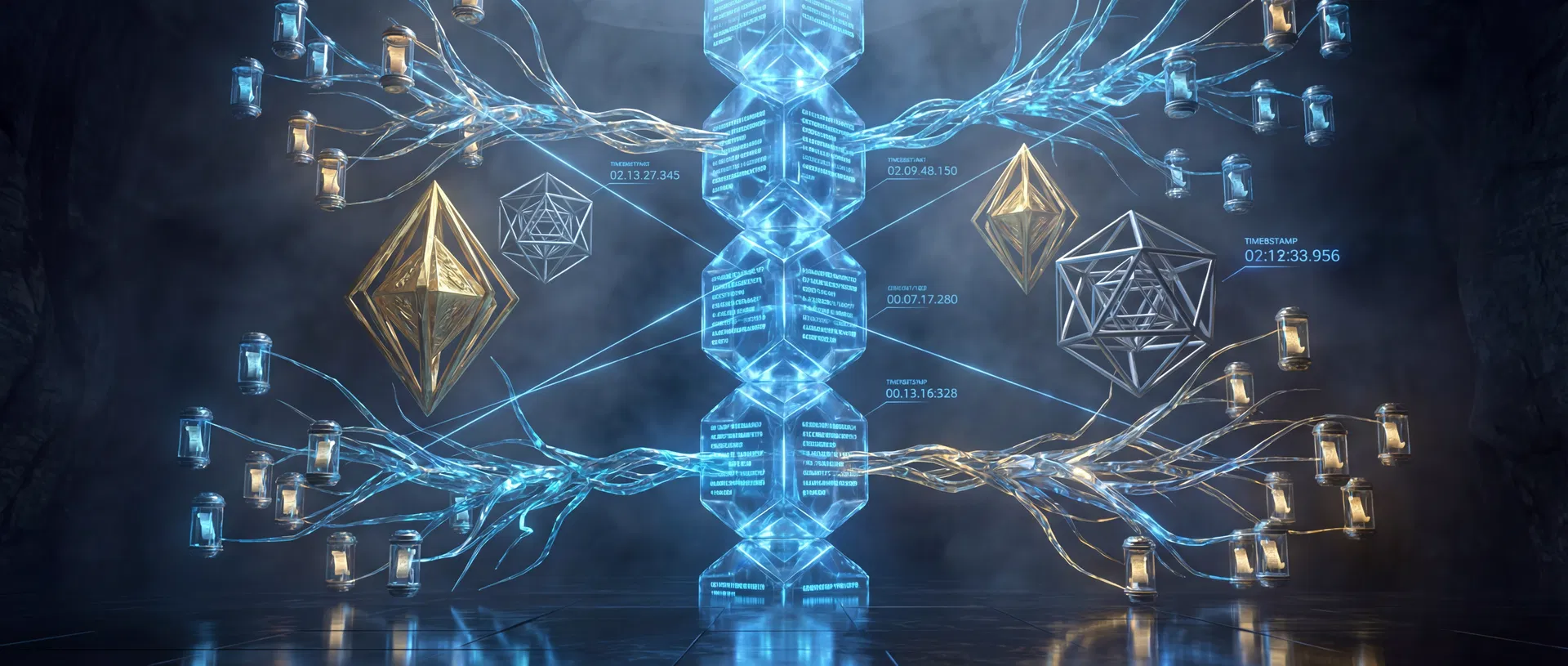
Post-quantum readiness: why it matters now.

Current public-key cryptography (RSA, ECDSA) will be broken by sufficiently powerful quantum computers. Decisions made today that are signed with classical algorithms will be retroactively repudiable once quantum computing reaches cryptographic relevance. The platform uses NIST-standardized post-quantum algorithms (CRYSTALS-Dilithium, CRYSTALS-Kyber) to ensure that decision records anchored today remain non-repudiable regardless of future quantum computing capabilities.

This is not a future capability. The post-quantum signature stack is implemented in the current architecture. The quantum execution path (Qiskit-based circuit compilation) is available through cloud simulation today, with hardware routing configurable when quantum hardware reaches sufficient qubit counts and error correction levels.

Cryptographic stack

SHA-3

Keccak-based hash family. Provides collision resistance and pre-image resistance for decision record integrity.

CRYSTALS-Dilithium

NIST-standardized post-quantum digital signature scheme. Lattice-based, resistant to both classical and quantum attacks.

CRYSTALS-Kyber

NIST-standardized post-quantum key encapsulation mechanism. Secures key exchange for encrypted decision transmission.

Hyperledger Fabric

Enterprise-grade distributed ledger. Provides immutability, distributed consensus, and independent verifiability for anchored decision records.

PROV-O format chain-of-custody.

Every decision record follows the W3C PROV-O provenance ontology, ensuring that the chain-of-custody is machine-readable, interoperable, and independently verifiable. The provenance record captures: who requested the decision, what evidence was consulted, which reasoning paths were taken, what contradictions were detected and how they were resolved, which compliance gates were applied, and what the final output was. This is the foundation for regulatory audit, internal governance review, and third-party verification.

How contradictions are surfaced and resolved.

The next layer: what happens when parallel reasoning branches disagree, and how the system resolves contradictions through evidence augmentation.