
Data Centers
Decision infrastructure for cooling optimization, capacity planning, and operational efficiency.
Data center AI tools optimize cooling and power independently, missing the interdependencies that cause cascading failures. A cooling optimization that reduces energy costs by 8% but increases thermal stress on critical equipment by 15% is not an optimization; it is a deferred failure.
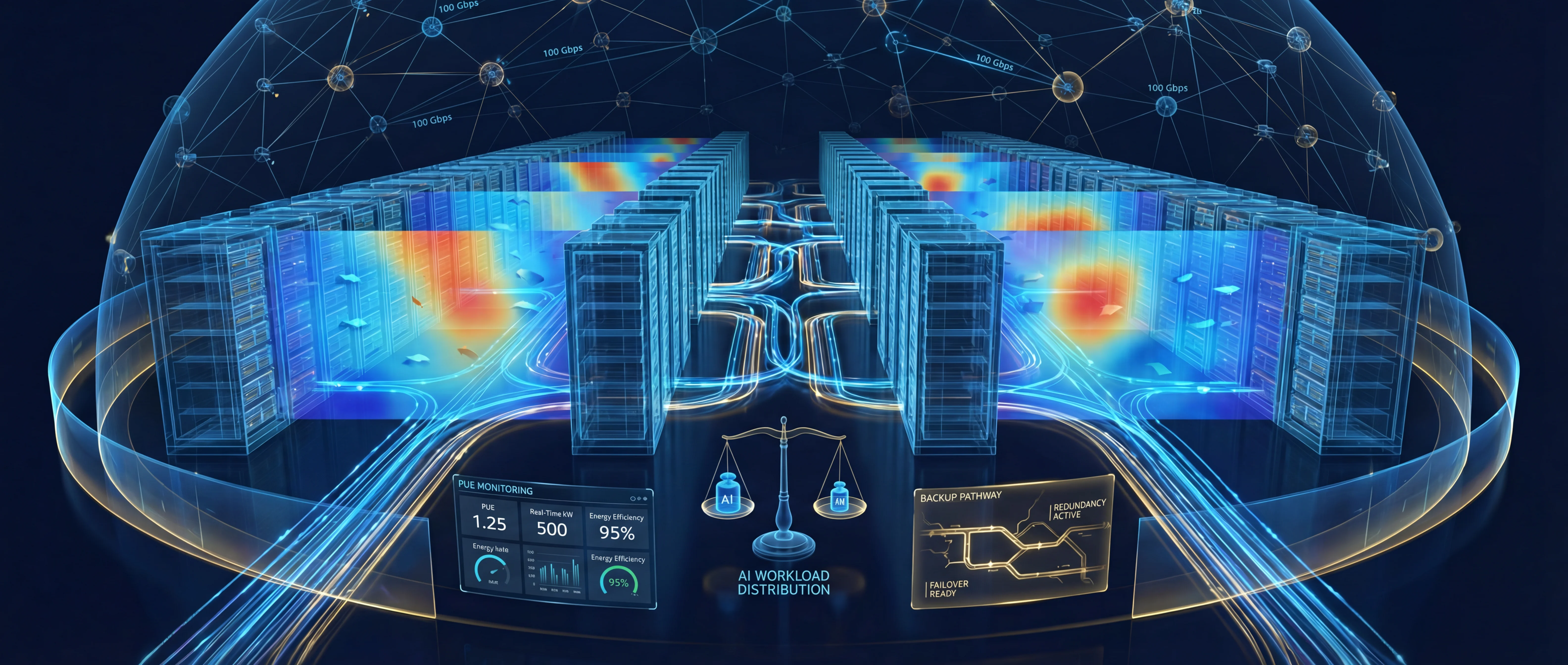
The instrument deploys parallel reasoning branches that simultaneously model thermal performance, power efficiency, equipment stress, and capacity headroom for every operational decision. The contradiction engine surfaces where efficiency recommendations conflict with reliability margins.
Industry Context
The global data center market exceeds $300B annually, driven by cloud computing growth, AI workload expansion, and edge computing deployment. Power consumption is the dominant operational cost and the primary constraint on capacity growth. The industry faces increasing scrutiny over energy consumption and carbon emissions, with regulatory requirements for efficiency reporting and renewable energy procurement expanding across jurisdictions. The convergence of high-density AI workloads with traditional enterprise computing creates thermal management challenges that exceed the capabilities of traditional cooling optimization tools.
Capability Configuration
Multi-objective thermal management balancing efficiency, equipment longevity, and reliability margins. The system models the interaction between cooling decisions, workload placement, and equipment thermal stress to prevent efficiency optimizations that degrade reliability.
Scenario-based growth modeling with power, cooling, and space constraint analysis. Parallel branches model different growth trajectories and their implications for infrastructure investment timing.
Thermal-aware workload distribution that prevents hotspot formation. The system optimizes workload placement across racks and halls to maintain uniform thermal conditions while maximizing utilization.
Equipment failure probability modeling with evidence-traced maintenance recommendations. The system combines equipment telemetry, environmental conditions, and maintenance history to predict failures before they occur.
Multi-scenario energy procurement analysis balancing cost, carbon intensity, and supply reliability. Parallel branches model different energy market scenarios and their implications for procurement strategy.
How the Framework Could Be Applied
Hypothetical: Cooling Optimization Under Competing Constraints
Decision Surfaces
Deployment Phases
Map facility topology, monitoring systems, and operational constraints
Connect BMS, DCIM, power monitoring, and environmental sensors
Tune thermal models for facility-specific characteristics
Shadow mode with thermal simulation validation
Full deployment with real-time monitoring
Framework Application
How the instrument's core architectural components are configured for this sector's specific decision requirements.
Multi-objective facility optimization
Deploys parallel branches for efficiency, reliability, capacity, and sustainability objectives. Each branch optimizes independently before the synthesis layer identifies conflicts between efficiency and reliability.
Efficiency-reliability conflict detection
Identifies cases where cooling or power optimization recommendations create thermal risk, equipment stress, or reliability margin erosion. Prevents the deferred failures that single-objective optimization creates.
Facility data integration
Ingests BMS data, DCIM metrics, power monitoring, environmental sensors, and equipment telemetry. Maintains real-time data freshness for operational decision support.
Decision Classes
The categories of decisions this sector deployment addresses, their frequency, and the stakes involved.
Operational Decisions
Real-time cooling, power distribution, and workload placement decisions affecting facility efficiency and reliability.
Equipment reliability, energy costs, SLA compliance
Capacity Decisions
Infrastructure investment, expansion timing, and technology selection decisions with multi-year implications.
Capital investment, capacity availability, competitive positioning
Sustainability Decisions
Energy procurement, carbon reduction, and efficiency improvement decisions affecting environmental performance.
Carbon footprint, regulatory compliance, stakeholder expectations
Governance Requirements
Standards and regulatory frameworks the instrument is configured to support in this deployment context.
Uptime Institute Tier Standards
Data center reliability and availability classification system.
Operational decision documentation compatible with Tier certification requirements
EN 50600
European standard for data center facilities and infrastructures.
Facility management documentation aligned with EN 50600 requirements
ISO 50001
Energy management system standard for systematic energy performance improvement.
Energy optimization documentation and performance tracking compatible with ISO 50001 requirements
Configure for Data Centers
Begin with an architecture review to map your decision environment, identify integration points, and configure the instrument for your operational requirements.